

Saying I rode a 17:37 on Levens, or an 18:16 on the C10/4, will mean very little to most of you. If I told you of my sadness that the mighty V718 will never return to its former glory, you will probably look blank at me. These are course codes, the British time-trial scene’s own cryptic language.
When the British government imposed a road-racing ban in the 1890s, cyclists had to get inventive, and the time-trial was born. It allowed them to race but under the nose of the authorities. Going off at one-minute intervals, no one could prove that they were racing. The course codes indicate the location, and they’re deliberately tough to decipher.
My bike racing life began at one of those time-trials back in 2014. The ‘Fonaby 1 Lap’, a nine-ish mile course. Thirteen-year-old Joe walked into Great Limber village hall with his £6 and received a race number in return. Wearing a flappy jersey and riding an 8-speed Raleigh Revenio road bike, he posted a time of 27:52.
Twelve years after walking into that village hall for the first time, I still pay the same £6 and ride the same Fonaby 1 Lap course. I now hold the course record: 17:36. Twelve years, ten minutes faster.;


I’ve raced my bike all over the world, but there’s a beauty that I ironically can’t quite articulate about returning to the Club TT scene. It’s the same sign-on sheet, the same faces at the start line, the same pre-race routine. It’s like stepping back ten years in my life.
The last three seasons, I’ve averaged one time trial per year. Redlands. 3rd, 1st, and 4th. Each time, I hop on my TT bike two weeks before and do some shakeout sessions. I enjoy it to no end. I always say I’ll spend more time on the TT bike, but it never quite fits with my schedule.
Then, last summer I was sitting in Boulder, watching the British National TT Champs. I had serious FOMO. I committed to myself there that I’d race Nationals in 2026. I also knew there was no better prep than the humble Club 10.
Racing that National Champs TTs is perhaps the most selfish thing I have ever done as an athlete. I didn’t race for my sponsors, I raced as ‘Individual’ in a blacked-out skinsuit. I didn’t race because I thought I would win the jersey - I’m a realist. I didn’t race for financial gain - if anything, it cost me money. I raced for one thing: myself.
Finding myself back in the UK for August, the TT bike was sitting at my parents’ house, and I was staring at an empty race calendar. I thought, why not continue that good time and go back to my roots? It’s been a blast. I’ve broken my own course records on the local courses. Rode a 17:37, a new PB, for 10 miles. I rode 18:16 on my local Club 10 course. I’ve been trying to crack into the 18s since 2018; now I’m questioning if there’s a 17 in there.
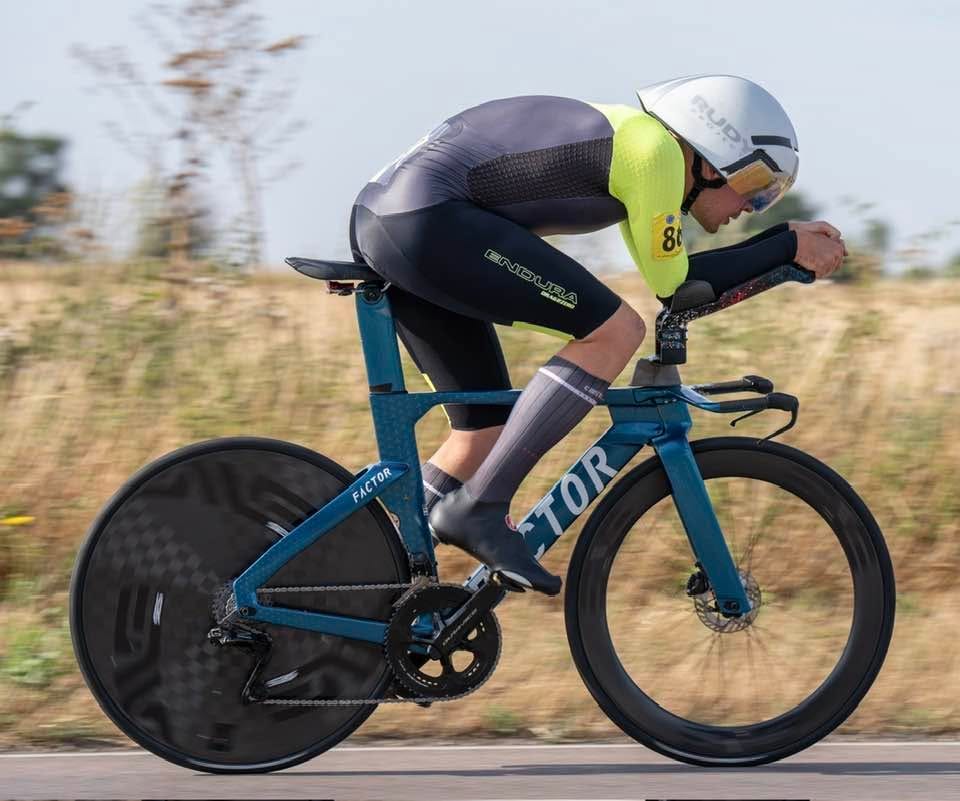
I went 3rd at the National 25 Mile TT behind a storming John Archibald and an ever-strong George Peden. I’ve had a thoroughly good time. It’s walking back into the village hall after the race to compare times. It’s the same conversations and questions with everyone, no matter how fast they are. It doesn’t matter if you’ve done a 25-minute 10, or a 17-minute 10; that headwind out was still a bitch, and getting caught at the roundabout still cost you a few seconds.
It’s the unserious seriousness. We’re all racing hyper-optimised bikes out of cars that cost half as much. We’re all scratching our heads over watts and aero. We’re all trying to answer one very simple question: how do I get faster?
I often get asked how I pace a TT. I never have a good answer; “I just do” is my reply. Racing a TT is one of the few times in bike racing that I achieve flow state. My body, brain and bike all work together. There’s something in my subconscious that knows how to regulate the effort. My brain empties; it just knows what to do.
Am I naturally disposed to it physiologically? Am I good because I enjoy it? Do I enjoy it because I’m good at it?
I imagine it’s a bit of everything; add in that it’s the discipline I cut my teeth in as a teenager. Almost every Tuesday night from that summer in 2014, I’d be doing a Lindsey Roads Club TT. All of those miles have clearly added up.
Halfway through writing this I remember I wrote an article for CyclingTips on TTing back in 2020. The link to that piece is now dead (thanks, Outside), but here’s an extract I found in my old drafts:
“The oxymoronic nature of the TT scene is what I love most. It’s a chasm between technology and ‘retroness’. Obsessiveness and friendliness. On one hand, you have space-age kit. There are 3D-printed handlebars and custom-made fairings on helmets. Amateurs regularly visit wind tunnels, and the talk of the carpark is watts and CdA. It’s a simple sport, you can do it on a borrowed bike, or, you can spend twenty grand. On the other hand, there’s not a timing chip in sight, and you can still enter races by postal entry. Each rider is timed with a simple stopwatch and your number dictates the order you start in. To find the start line, there’s niche instructions like: ‘the start is in the layby after the third lamppost, north-east of village X’.”
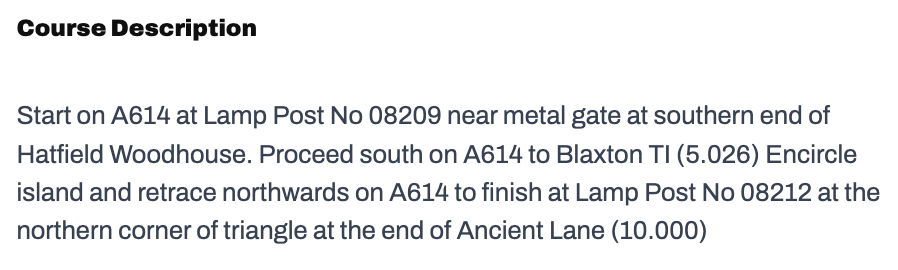
Tomorrow I’ll be racing the National 10 on the O10/1 course. It’s a pan-flat out-and-back course. About as traditional a 10 as you can get. Here’s the official course description:
I don’t think I’ll win it, but I reckon I’ll be close. I know I’ve got the power and the brain to be competitive; I need to work on the aero side of things. That’s my biggest problem at the minute. Hopping between disciplines, I always feel slightly underprepared against those who race consistently.
I’m also on a borrowed bike. Alexey Vermeulen, an incredible human, gave me his bike for the season - borrowing equipment is also a story of my time-trialling life. That also limits how much money I want to spend on making myself faster on it, knowing I’ll be giving it back.
Going into 2027, I’ll be looking to get my own TT bike, which means I can put as much time and money into making myself as fast as possible on it. The quest for gains in the time-trial scene never ends. Most guys at the pointy end of these races are more optimised than top World Tour pros.
This article is far from what I’d normally write about. Time trialling is not a good spectator sport, nor a good TV product. It doesn’t hold the answers to improving the popularity of the sport. But at the same time, I don’t care. I love time trialling for what it is.
It’s the closest thing our sport has to a 5k, or a marathon - a distance that people of all ages and abilities can measure themselves against. I feel the World Tour should have more time trials in stage racing. This year’s Tour de France Femmes avec Zwift showed how a well-placed TT in an undefined GC battle can throw a cat amongst the pigeons.
There’s nothing cool about being a time trialist. But I was a football goalkeeper before I was a cyclist, so apparently I don’t care about appearances. I wish I had the same natural love and skill for time-trialling as Maggie has for bunch finishes, as Matt Bostock does for a crit, or Bjorn Riley does for riding a mountain bike. I also wish domestic time trialling paid what domestic gravel racing in the US. But of course it doesn’t; why would it?
The race against the clock is a race against yourself, for yourself. It’s the weird, wonderful, and geeky discipline that I owe my whole career to.
When digging up that old CyclingTips article I wrote in 2020, I ended on a line that I’m going to end on today too.
My racing career started at the club TT, and it’s a pretty safe bet that one day, my racing career will end at a club TT too.


While you’re here…
I’ve added a paid subscription and a ‘Buy Me A Coffee’ link to this post. This allows me to write articles that don’t necessarily fit in at one of the normal outlets. Thanks for your support.
https://www.buymeacoffee.com/joelaverick
The following brands are either financial or equipment partners of mine, and allow me to do cool stuff.