

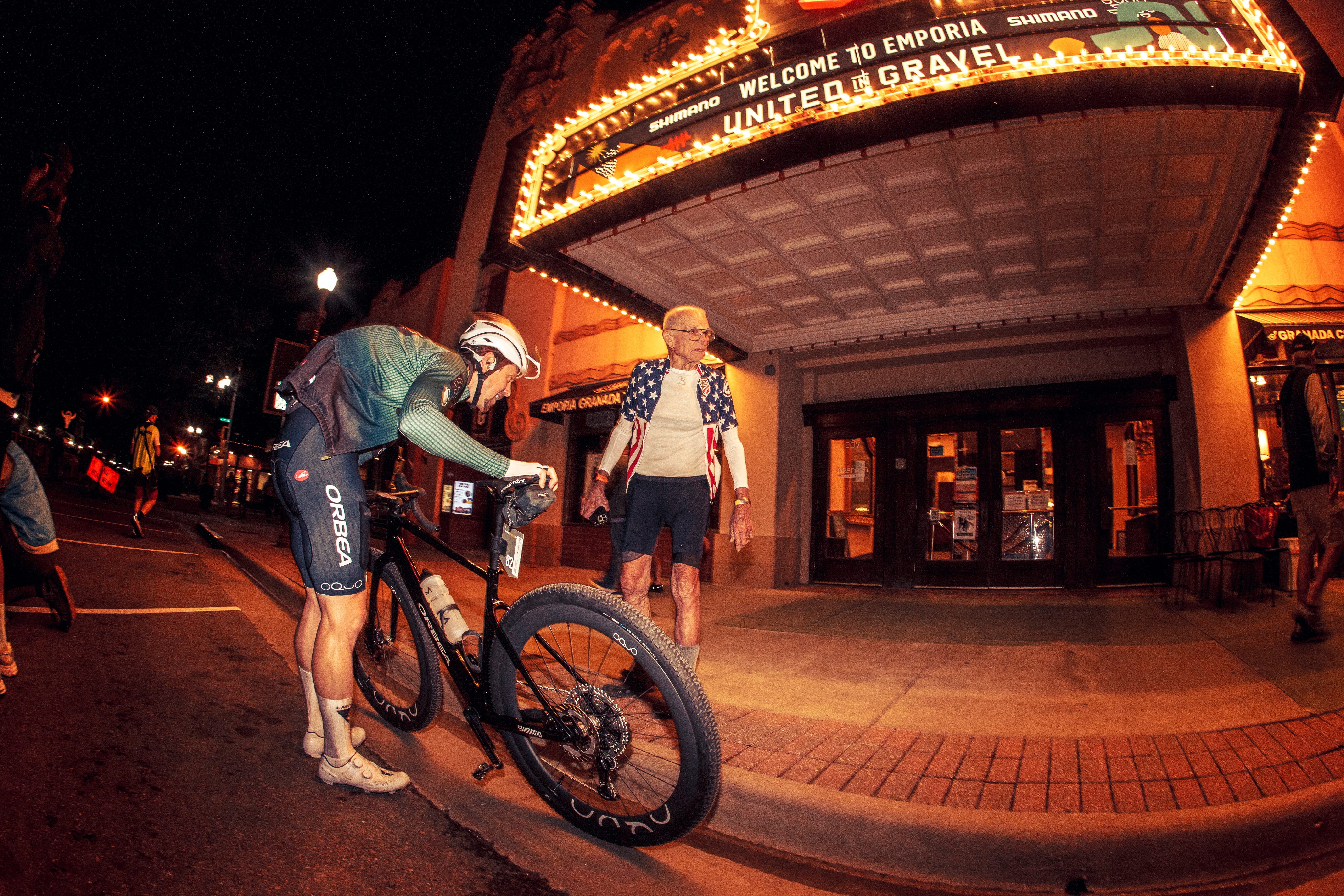
Unbound is in the rearview mirror, and the world of gravel has left Emporia for another year. The race always brings up plenty of talking points, and marks the point in the season where two of the three biggest gravel races are done for the year.
If they haven’t already, brands and organisers will be starting to figure out their 2027 priorities and strategies for the year ahead. I had plenty of thoughts on my flight back from the States, so I decided another piece was needed.
1. The Triple Crown is on.
Traka. Unbound. UCI World Champs.
If it hasn’t been already, I’m designating that trio the gravel triple crown.
Both Sofia Gomez Villafane and Mads Würtz Schmidt only have one to go, and with many dubbing the Aussie World Champs course a true gravel race, the odds are in their favour.
If either of them pulls it off, it will be the greatest gravel season ever.
Side note here. The fact that UCI Gravel Worlds clashes with the penultimate race in the LTGP is dumb. Nobody cares which of you chose the date first, can you both just talk so there’s not a clash in future? Thanks.
2. The world’s best male gravel racer isn’t in the LTGP.
The Life Time Grand Prix has never been a gravel series. It calls itself “the professional movement of off-road racing”, yet the global narrative has always positioned it as a gravel series. With a 50:50 split, the LTGP is as much a MTB as a gravel series.
There is no doubt that the best male gravel racer in the world right now is Mads Würtz Schmidt, but with him not being in the Grand Prix, it does raise questions. If neither the world’s best male MTB riders nor gravel riders sit in the LTGP, it’s an interesting dilemma.
Life Time has never had the issue of the clear best male pro gravel racer not being in their series. My 2c is to lean into the multi-discipline angle and add an event or two on road bikes too.
3. Teamwork works.
Quelle surprise as teamwork works in a bike race. I feel vindicated, and this is a bit of an ‘I told you so’. When I said a few years back that true teamwork can change gravel racing, I was accused of being too much of a roadie.
Now we’ve seen just how important teams can be, the question is, who can follow?
Here’s what I wrote back in 2024:
“Specialized is the obvious choice.
It makes sense from a geographical perspective; they have one of the biggest marketing budgets too. They’re already close with Matt Beers, Sofia Gomez Villafane and Howard Grotts. They also sponsor a lot of individual athletes: Ian Boswell, Lance Haidet, Gee Schreurs (via SD Worx), Sarah Sturm. They could reasonably pull all of this together to create a full-blown team.
“Wait, didn’t Sarah Sturm lead out Gee at Unbound even though they’re not on the same team?”, I hear you cry. Well, yes. Maybe. Kind of. It’s complicated.
I imagine if Specialized launched a full-blown gravel team then the Canyon Collective would follow suit.”'
4. But who can actually afford a team?
A pro racing team is a money game, trust me, I’ve tried (trying) to launch one. With Specialized’s team easily in the seven-figures, and Canyon rumoured to be up there too, it’s not a cheap endeavour.
PAS Racing are one of gravel’s best teams and consistently proves they can compete at the biggest races. However, with the team not having a common bike sponsor, there’s a weird paradox where the riders both are and aren’t teammates. If Tobias Kongstad (PAS Racing, Specialized bike) came to the line with Magnus Bak Klaris (PAS Racing, Factor Racing), the tactics are an inherently different calculation than if Specialized Racing had two guys together.
Scott Bikes has a similar issue. Their male gravel roster is impressively deep - Brennan Wertz, Cam Jones, Matt Wilson - and while they don’t race like a team, they’re certainly in alliance. Now, imagine the three of them are singing from the same hymn sheet for one shared goal. That’s a lot of horsepower.
As I said, though, it’s a money game. The sponsor-alliance privateer hybrid squad is much cheaper than an all-singing, all-dancing pro team. And, unless you’re winning as often and controlling the narrative as much as Specialized, is gravel racing worthy of that seven-figure investment yet?
5. The gravel season goes quiet.
In the first half of the season, the biggest gravel races arrive in quick succession. Sea Otter, Traka, and Unbound are separated by only six weeks, with ‘semi-classics’ like BWR Arizona, Santa Vall, and Mid South around there too.
The post-Unbound slump is very real. Some of those ‘semi-classic’ level races - SBT Gravel, The Rift, Oregon Trail, Garmin Gravel Worlds - are coming up, but none that reflect the upper echelons of Traka or Unbound in terms of start list, cultural relevance, or media coverage.
This isn’t a new observation. I’ve said for years that I struggle to find the same excitement for the post-Unbound calendar as I do for the races that come before it. If I raced mountain bikes, it might be a different story, but in gravel we’ve built a calendar where two of the world’s three biggest races are over before summer has even begun.
6. Should the LTGP expand?
Life Time’s decision to remove The Rad and Crusher in the Tushar aged like fine wine and truly opened up the series. However, having a professional series that only races six times per season isn’t enough from a racing or media angle.
After Unbound, the series has 2.5 months of nothing until Leadville. Leadville brings a week of hype, and then the series largely quietens down until the Sugar’s double header at the end of October. While Chequamegon deserves its place on the schedule in September, it doesn't carry the same global significance as the other marquee events
Long term, I believe the LTGP should aim to grow to ten races. The current gravel calendar is too concentrated around the first half of the season. A summer event in Oregon could make sense, and there's already a proven blueprint there if you call Chad from Breakaway Promotions. An East Coast race could broaden the series geographically. You could even experiment with a Grand Prix/Wildcard-only short-track MTB race at Sea Otter. Or, dare I say it, add Tulsa Tough to the mix.
There’s a lot of nuance to expanding the series, especially when choosing which towns you expand into, but that’s an article for another day.
7. LTGP Wildcard Consistency.
I haven’t given this too much thought, but with both Matt Wilson and Skyler Taylor wildcarding into the Grand Prix two years in a row, it does question the overall selection protocol.
Paradoxically, I could argue that the selection profile is actually too detailed. I know elite sport is full of ifs and ands, but if Matt Wilson didn’t flat out of the breakaway in Big Sugar, he would be in the LTGP. It’s crystal clear to everyone that he deserved that spot.
I have heard an argument that the Wildcards should get auto-qualification for the year after, but that’s silly. There’s a separate, much-tighter argument that there should be fewer pre-selected spots and more Wildcards, which would, in theory, improve the series’ competitiveness.
Furthermore, the fact that we choose the Wildcard from the two gravel events (Sea Otter, Unbound) when it’s a 50:50 gravel:MTB series, deserves bringing up. If we throw in my Sea Otter short-track race idea, that would help ;)
8. How soon will ultra racing scale?
There’s an argument to be had that ultra racing in 2026 is how gravel racing was pre-2020. It’s niche, but growing in both popularity and sponsorship dollars.
The outcome remains to be seen, but as athletes continue to receive $$, then further emphasis will be put on winning. We’ve already seen a narrative of cheating begin to unfold at the top, another sign that it’s going towards all-out racing.
But, I thought the whole point of ultra was the story behind it all? Wait, isn’t that what we said about gravel…
9. Gravel keeps growing.
North of 500k views on the YouTube livestream, and the highlights are currently sitting at 180k. These are big numbers; gravel racing is still growing. Of course, Unbound is the biggest race in the discipline, so these numbers will be higher than the rest of the races, but that doesn’t undermine anything.
Gravel racing is young; it will make mistakes and have headwinds, but there is no doubting that it continues to grow in relevance. There’s no better time to be a part of growing the sport’s future.
Some thoughts on media:
I apologise that I haven't done any deep dives recently. I feel that I set the research bar so high with The Peloton Economy that anything smaller doesn't feel worthwhile. That's the wrong way to think about it; listicle and long form both have their place
There’s also an element of me writing to the reader. If you’re reading this section, then you’re on Substack, and thank you. But the reality is that most of my traffic now comes from what I've dubbed 'swipey posts' on Instagram - the article cut down into individual slides.
For reference, here is the difference between my Substack and Instagram statistics on a recent post:


Metrics aren't everything to me, but the goal of my writing is to get people talking and help change the sport for the better. If a format change means the piece reaches more people, that's a good thing.
There's also an algorithmic reality. Instagram pushes content to new audiences in a way Substack does not. On Substack, my ceiling is more or less my subscriber count. On Instagram, a post can find people who've never heard of me. This is similar to how YouTube works, too.
The broader media context matters here too. Attention spans are shrinking, and reading habits are changing. I often joke that most of my articles are toilet reading. This means they need to be of a certain duration and layout; the mini-sections I’m doing aren’t an accident.
Media outlets rely on web traffic to sell advertising and are caught in an impossible situation. This is why we’re seeing paywalls pop up everywhere. It’s also why we’re seeing more sponsored content on media sites; these articles are written in a journalistic style, but they are as far from journalism.
There is a prime culprit of this in cycling media, who I’m not going to name. It’s a shame, because they used to be the gold standard of journalism. I understand why they’re doing it, as the economics of media don’t leave many options, but it still sucks.
What’s particularly deceptive is that they will note in print that a piece is ‘produced in association with Brand X’, then run a very similar article online without the disclaimer. They are probably doing much better financially now because of this, but the ‘Independent Journalism’ that runs on their website ticker holds little truth.
Glass houses, I hear you cry. I am sponsored, so I have bias. Guilty! I feel there's a difference. I'm sponsored as an athlete, but when I write about my sponsors, I make my conflicts of interest abundantly clear. I also see myself as a commentator, not a journalist. I don’t dress up my opinion as independent reporting. Maybe that’s a thought for another day.
Anyway, this section ended up being much longer than I intended. All I will say is that I’m happy my livelihood doesn’t depend on my writing, and that I don’t have any plans to go into full-time journalism!
Thanks for reading,
Joe
While you’re here…
I’ve added a paid subscription and a ‘Buy Me A Coffee’ link to this post. This allows me to write articles that don’t necessarily fit in at one of the normal outlets. Thanks for your support.
https://www.buymeacoffee.com/joelaverick
The following brands are either financial or equipment partners of mine, and allow me to do cool stuff.
You may have just inspired me to write about a LTGP 'fantasy calendar' - what it could look like with 10 races.
I assume you’re talking about VeloNews/Velo (no need to confirm or deny), but I struggle to believe that their being overtaken by spon-con came from within. Perhaps it’s taken on a momentum of its own now, but its purchase by Outside (or, more accurately, the venture capital firm that controls Outside) is a pretty clear and foreseeable turning point. CyclingTips underwent a similar transformation, with the new owners fixated on ROI over any semblance of a quality product to the point where the site is no longer meaningfully navigable. Pinkbike was also purchased by the same VC firm as Velo and has seen a similar ramp-up in spon-con and drop in the quality of journalism.
All that is to perhaps say that while attention spans may indeed be shrinking, that both informs and is informed by the available media, and the quality and length of said media is generally reduced both as a response to shortening attention spans and because it is seen solely as a product, devoid of your desire to change the sport for the better. I think this is also inextricable from the general consolidation of online and physical media ownership in the US and worldwide - the importance of Instagram as a platform in growing your own visibility is illustrative of this.
No easy answers here, but curious how true this rings to you as somebody who’s better placed within the industry than I am (that is, not at all).