

Hi everyone, I probably should mention that I do some freelance work for the Unibet Rose Rockets, but that hasn’t influenced my writing of this piece. I’m simply a huge fan. I hope you enjoy! - Joe
Cycling has convinced itself that results are enough. If you win races, fans will magically appear. But there is only one Tadej Pogačar, and the rest of the sport would be silly to depend on unicorns.
Somehow, it is a group of twenty-something YouTubers leading the way. The Unibet Rose Rockets are proving that it is not rocket science at all.
Just be honest.
Teams assume fans only care about perfection. But if everything were perfect, would anyone care?
People are tired of cringey content, empty press releases, and PR trained answers. They want real humans. The days when people simply cared about the result at the final whistle or who crossed the line first are over. In the social media era, everything is up for discussion. The process matters just as much as the performance.
It’s a cultural shift: brutal honesty beats manufactured perfection.
Look at Wrexham AFC and Williams Racing. Both were historic names stuck at the bottom and drifting into irrelevance. Then they opened the doors. Welcome to Wrexham took fans into the boardroom. Williams handed their Team Principal, James Vowles, a microphone and let him tell the truth. Honest communication rebuilt belief. That’s when people started to care again.
Of course, Wrexham had a leg up with celebrity appeal. But attention isn’t the same as loyalty. Loyalty came from honesty.
The Unibet Rose Rockets, a team that formed less than three years ago from a YouTube channel. have taken a leaf from the same book.
When they can’t afford something, they tell you why. When they sign a crazy expensive rider, you see the human reaction. There’s no mystery. No spin. You’re seeing the operation as it happens.
And because fans see the work, they feel part of it. When the team goes well, supporters genuinely feel like they helped push it there. That is a powerful thing, and ridiculously rare in professional cycling.
Even having a real name makes the Rockets unique in professional cycling. The sport is obsessed with sponsors first, identity second. But the Unibet Rose Rockets will always be the Rockets, no matter which brand sits first. A name is an identity. It is remarkable how that is seen as revolutionary.
No wonder fans finally feel like they have a team they can get behind.
Team first, riders second
Welcome to Wrexham and Drive to Survive did something that sport had rarely done before: they told a human story, not a sports story.
They made stars out of unlikely characters. Paul Mullin is a brilliant footballer, but he’s no Messi or Ronaldo. Before Welcome to Wrexham, most fans outside League Two had never heard his name. Now he’s a cult hero. Why? Because we got to know him.
The Rockets understand this better than anyone in cycling today. Take Lukas Kubis. The Slovakian was almost completely unknown before he joined the Rockets. Now fans care when he races, because they care about the team he represents.
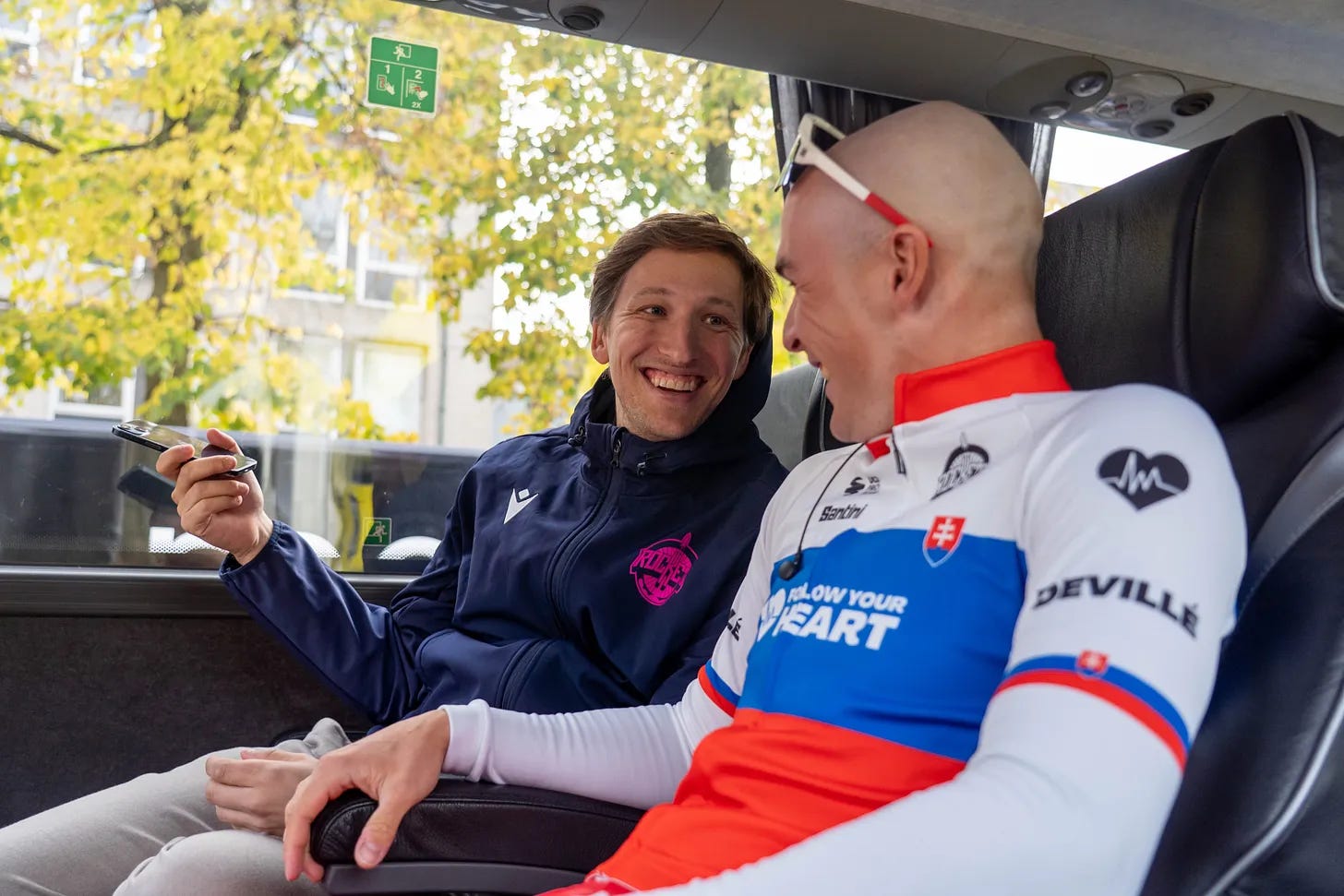
As Mitchell Minnaard, the Rockets’ Head of Communications, told me:
Our goal is to be the most likeable, and best followable team.
Lukas finished sixth at Omloop Het Nieuwsblad, a WorldTour race, this spring. Uno-X won with Wærenskjold and it was a big success for them. But we got more media from sixth place than Uno-X got from winning. Why? Because people cared about who the team was, they wanted to know who that Lukas Kubis guy was.
Then came our realisation:
If sixth place can do that…imagine if we won a stage at the Tour de France.
Cycling always gets this backwards. Teams rely on riders for identity, so when a rider leaves, the fans leave too. How do you build anything lasting like that?
The media strategy everyone missed
Sports teams traditionally rely on other people to tell their story. If the media doesn’t show up, their existence disappears.
The Rockets own their channels, and not only do they own them, they boss them too.
They’re most known for their YouTube channel that the team was born out of. It brings long-form storytelling, it’s almost like a pro-cycling reality show.
Their social media, Instagram and X (Twitter) is more reactive and fun. There are memes, lifestyle and humour. It’s fast paced and largely unhinged.
Then there’s their Substack, a recent addition to the Rockets media armoury. It gives context to what’s happening and a direct communication channel between management and fans.
The beauty of it? All four platforms appeal to different audiences, but they’re all connected to one ecosystem.
Just think, when was the last time you heard directly from Dave Brailsford at Ineos Grenadiers, or Ralph Denk at Red Bull Bora Hansgrohe? Not the team account. Not a press officer. Them.
Oh, and real-world events too. Not invite-only launches, or media days. Actual in-person fan engagement.
What’s the story line?
None of this matters without a storyline.
Sport relies on structure and meaning. Leagues, knockouts, promotion, relegation. Every match has context. Every moment feeds into something bigger.
Cycling does not have that. There are no clear stakes. How is it that finishing fifth can be a huge success one week, but a disappointment the next?
The Rocket’s breakthrough came from failure. A video where the whole team DNF’d became their most-watched of the season. Why? Because it was real. A group of riders who tried, cracked, and had to deal with the very human truth of failure.
They kept experimenting. They tried following riders at races. But without a bigger story in play, it still didn’t land. They didn’t need more wins. They needed a plot which everything could feed into.
Mitchell Minnaard, explains more:
I’m the first to say we did a lot of shit, and we’ll do a lot of shit in the future. But, we are learning from it and the videos we published along the way brought us to this strategy.
During the year, we asked ourselves, “What’s the goal for the rest of 2025?” Our goal was to be in the Top 30 in the UCI Rankings, and we needed UCI Points. We came up with ‘August Madness’, a month with a lot of stage races and UCI points. That clicked with our fanbase. Every race played into a bigger picture of our ranking. That’s when it clicked.
Our fanbase is the people who watch the Tour de France, but don’t follow every race and result. So it’s all about giving the right context and a good storyline. With UCI Points, we saw an opportunity to create a storyline that went beyond individual races.
If we don’t get it right?
If we don’t get it right, professional cycling is in trouble.
Evolve or die. I’ve said it before and I’ll say it again: as the gap between the top and bottom World Tour budget continues to stretch, the outcome becomes painfully obvious.
If you’re not innovating, you’re drowning.
The sport is splitting in two. A handful of super-teams hoovering up the talent and wins, while everyone else fights just to exist.
The bottom could very easily fall out of the WorldTour, and fast.
Because here’s the brutal truth: the money isn’t going to magically balance out. If teams keep relying on tradition, spreadsheets, and hope, they’ll get left behind. Just ask Arkea, or Lotto.
Building something bigger than race results is the only way to future-proof a team, not just against future sponsorship, but against irrelevance.
When you build identity and connection, you attract talent - riders and staff - who want to build something that matters. You give fans a reason to stay, even when the results wobble. It’s a self-fulfilling prophecy.
Where to start? Start simple. Open your doors. Tell it as it is. You’ll get a lot wrong, but you’ll learn.
A message to the sport
Sport is entertainment.
Look at the Ineos Grenadiers, nee Team Sky. A team that once redefined cycling is now struggling with relevance. Remember when they were untouchable? When marginal gains felt like magic and the rest of the peloton was years behind? Those days are long gone.
Instead of adapting, they put up walls and leadership became defensive. Their culture slipped, and once that goes, everything goes with it. You cannot expect fans to buy into a team that barely looks like it believes in itself anymore.
The Rockets are the opposite of that. They know the game has changed. They understand that people want to feel involved. They are building a fanbase by telling the truth, even when it isn’t pretty. They are showing the work, not just the results. They are having fun, letting people in.
The Rockets are, dare I say it, perfect. I can’t find a single fault in their strategy.
Cycling can cling to tradition and wonder why few care. Or it can follow the teams who are actually giving supporters something to believe in.
Allow me to repeat the first line of this article:
If you’re not winning, and you’re not appealing to fans, then what the hell are you doing?
— Joe
-
I’m realising there’s a lot more I want to say, but I’m already way over my self-imposed word limit. The Rockets’ approach is simple: put fans first. Build a storyline people can actually follow. Make them feel part of it.
This is my future. Maybe that means building my own team. Maybe it means helping others rethink what a cycling team can be. Maybe it means giving the Rockets my CV at some point. I never planned to care about media strategy or fan engagement. I just wanted to race bikes. But somewhere along the way, I learned something important. Attention matters. Story matters. Connection matters.
We don’t have to accept the systems in place just because they exist. Especially when they’re clearly broken.
Why not build something better?
If you liked this, you may also like:
The following brands are racing partners of mine which allow me to do cool stuff.
Thanks for this Joe. So many smart points here. I agree!
Nice, Joe.