

This article was co-authored by myself, Joe Laverick, and Peter Abraham.
Beneath the headlines of growth, the Women’s World Tour is blindly sleepwalking into the broken economic model that has plagued men’s pro cycling for decades: teams depend on a single sponsor’s marketing budget, or philanthropy from wealthy benefactors, to survive.
The unavoidable reality is that professional cycling, for both men and women, lives inside an economic conundrum where teams neither receive a share of media rights revenue nor have budget caps. In this environment, teams are encouraged to spend more and more money with the sole goal of winning the biggest races. However, the men’s World Tour has proven that winning does not equal financial security.
If winning alone does not always work for the men’s World Tour, a market that has much bigger reach than the WWT, then why are women’s teams trying to follow the same model? Even still, only a handful of riders have a realistic shot of winning the biggest races. So the smaller teams who cannot afford those riders must think outside the box to survive.
Teams are completely missing the opportunity to engage fans, both new and hardcore, from around the world. Fan engagement, not the ‘win at all costs’ model, is part of the answer for those teams. While winning is important, and every professional sports team should have the goal of winning, it is not the only part of being a professional sports organisation. Even the best teams do not win very often.
It would be easy to write this article specifically referencing the men’s World Tour, but that is so entrenched in tradition that it can be hard to change. The WWT is new and full of optimism. There are no traditions getting in the way of progress.
Most women’s teams are still built to do one thing: win. But most teams, in any given race, lose. If a team isn’t winning and isn’t giving fans a reason to care, what exactly is it for?
Teams need to build brands.
The advent of the Tour de France Femmes avec Zwift (TDFFaZ) in 2022 means that women’s professional racing is in front of millions of viewers across the world. The power of the Tour de France brand cannot be overstated. The television ratings and media attention there dwarf every other women’s cycling event. However, the TDFFaZ is only a nine-day event. How do these multi-million-dollar teams stay relevant for the other 356 days of the year?
The current economic structure of professional cycling teams is largely based on a single source of revenue: sponsors who pay to have their logo placed on the team’s assets. There are no ticket sales or media revenue that a team can depend on. The sponsoring brands hope to drive earned media in exchange for their sponsorship. The more a team wins races, the sponsors pray, the more earned media is achieved, and ultimately the more they benefit.
The problem with earned media is that the only way of guaranteeing it is to consistently win big, and no team wins all the time.
The vast majority of a team’s revenue is sponsorship income, and because of this the team is typically named after the brand giving it the most money that year. The team colors and identity often reflect this brand, changing from year to year depending on who writes the biggest cheque. This causes teams to constantly violate the most basic principle of good branding: consistency.
Imagine if the Dallas Cowboys NFL team, who have maintained the same logo, name and colors for sixty-five years, were “Team AT&T” one season (with that brand’s corporate colors) and then “Team Starbucks” the next season. It’s laughable, but that’s how pro cycling currently operates.


Over just the last ten years, one Dutch World Tour team has been called: Giant-Alpecin, Team Sunweb, Team DSM, dsm-firmenich, dsm-firmenich Post NL, and Team Picnic Post NL. Each of the six team names came with a different colour palette.
One team trying to change this, and operate more effectively as a brand, is the Unibet Rose Rockets, a men’s team that started with a YouTube channel four years ago. Their Head of Communications, Mitchell Minnaard said, “Our goal is to be the most likeable and most followable team with the biggest fanbase.”
Followable is the key word here. Most professional cycling teams are built to win, and of course that is a key goal for the Rockets, too. They see winning as just one part of their overall strategy. The team chose to invest heavily in media — their internal media team sits at more than twenty people — and while this was often at the expense of sporting performance, it was a decision that has also paid dividends to the team. The Rockets have a large, engaged fanbase that attracts sponsors and media attention at a greater value than their results would suggest.
And as it relates to branding, they are doing a lot of things right: the name of the team (The Rockets) stays the same even when they bring in title sponsors (Unibet, Rose). They have a thriving YouTube channel, with 135,000 subscribers. That’s more than either of the two winningest teams in the world, Team Visma lease a bike and UAE Team Emirates XRG. The Rockets’ team colors have stayed, maybe not identical, but at least similar, since they started.
In an interview with Olympics.com, the Rockets’ co-founder, Bas Tietema said: “Normally it’s an investor or multinational [corporation] who are starting a cycling team, trying to get better riders on board and then trying to get fans by performing well on the road. We believe that if we can take people inside our journey, then that could be the product.”
At the time of this writing, not a single women’s team is taking the approach of Unibet Rose Rockets. This is a huge missed opportunity. We know from talking to women’s cycling followers all over the world that fans of the sport want stories, personality and energy. Yes, fans love teams that win, but they want much more than that. Neither the teams nor their sponsors seem to understand this.
We do recognize that there are a few teams moving in the right direction, notably EF Education-Oatly and FDJ United-SUEZ. But even these two are only scratching the surface.
As it currently works, any additional money that a team gets goes immediately to signing better riders or trying to improve performance. But what if serving fans with better branding and engagement actually got more earned media for sponsors than incremental performance improvements?
After all, isn’t that the reason sponsors are there in the first place?
Treat the organization like a business, not a 1970s sports team.
The issue that many professional cycling teams face is quite simple: they are run the same way they have been for the last fifty years.
A majority of team managers would reject the idea that brand or media rank anywhere close to sporting performance. But the world has changed since the 1970s.
The advent of the internet and social media globalized fan engagement for sports teams and athletes. Teams are now able to circumvent traditional media channels (television/streaming and print) and connect directly with their audience. Most pro cycling teams seem to completely ignore, or do not understand, current best practices in media, marketing and sponsor activation.
Outside of pro cycling, many professional sports take a dual perspective on management: one side focuses on performance, the other on commercial viability and long-term growth. There is no better example than the Formula One World Champions, McLaren Racing. Leadership is split: Zak Brown drives commercial strategy and partnerships as CEO, while Andrea Stella oversees performance on track as Team Principal.
McLaren did not become Formula One World Champions by deciding whether on-track performance or commercial success were the most important. It staffed people in both roles. Stella’s job is to make the car as fast as possible, Brown’s to make the team as commercially appealing as possible. While each of the jobs have very different goals, both are mutually beneficial. Serving both brands and fans better brings in more sponsorship, and that money funds both sides of the team.
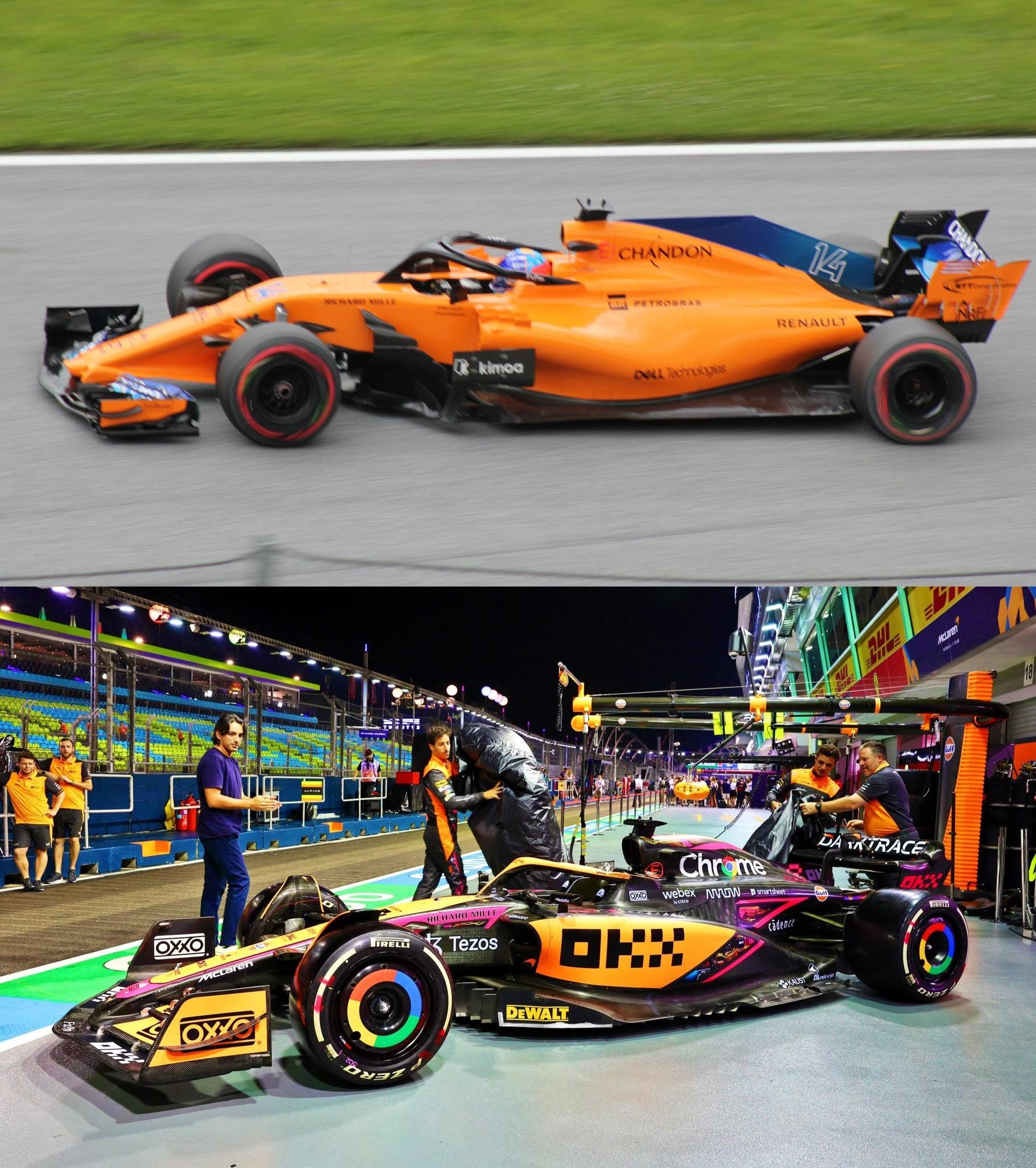
Most professional cycling teams do the opposite. They funnel as much money as possible into human performance, betting that winning more bike races is the only way to attract bigger sponsors.
That bet is risky, as race results are historically unreliable, and a team solely focusing on results doesn’t protect itself from a bad year. Building an audience away from results brings loyalty that doesn’t rely on podiums. It also brings something that teams can take to a boardroom, no matter how many or how few wins they have.
We can already hear the complaints of team managers: “We are already tight on budget, how do you expect us to be able to afford this?” The question shouldn’t be “How do we afford this?” It should be “How much money are we losing by not doing this?”
How would we run a WWT team?
Now, it’s all good looking at current practices, but what would we do if we were in charge of a women’s pro cycling team?
1. Start at the foundation
What does the team stand for and why does it exist?
Every strong brand or organization needs a purpose. This has to start with management, and it impacts everything the team does: the sponsors it attracts, the riders it signs, the races it travels to, the content it creates, the staff it hires, and just as importantly: the things it doesn’t do.
“We exist to win races” is not enough. Virtually every pro cycling team could use this. A proper mission or purpose should be unique to that particular organization. The team needs a North star that everything comes back to, and it cannot just be ‘racing for women.’
As an example, the Unibet Rose Rockets express what they do this way: We’re here to push boundaries, chase results, and tell authentic stories along the way. Note that “telling stories” is part of the reason they exist!
If we compare that with “UAE Team L’IMAD exists to empower women, nurture talent, and use professional cycling as a platform to inspire the UAE and the wider world to dream bigger, live healthier, and believe in the power of sport to create opportunity, unity, and progress.“
This says a lot and nothing all at once. Kind of a professional sports word salad. We challenge anyone in the organization to recite this from memory. The team has great riders, and fans follow them. But ask what the team itself stands for, and there’s no answer.
2. Hire the correct people
There needs to be someone experienced and skilled in charge of marketing, media and sponsor activations. This sounds so simple, but it’s actually very rare in the pro cycling space.
Most teams have a press officer, someone who writes race reports, manages rider interviews and posts results on social media but that’s communication, not marketing. The job we’re describing is different: building the brand, growing the audience and making sure sponsors get more out of the partnership than a logo on a jersey.
This person can’t report to a sporting Team Manager, where every budget conversation gets decided in favour of another rider. They need to sit alongside the performance side as an equal: cycling’s version of Zak Brown.
3. Create a distinctive brand identity
The name, the kit, the look of the bikes, the logo, the culture. Together they should make a team recognisable from a helicopter shot or a single Instagram post.
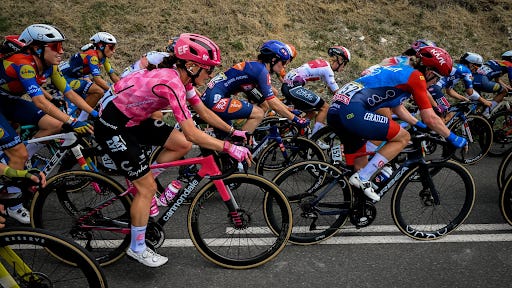
EF Pro Cycling is the best example in the sport. When the team rebuilt its identity in the late 2010s, it went further than most. The Rapha partnership fitted who the team wanted to be at the time, the films were better than anything else in cycling, and the pink kit could be spotted from the skies. The kit has outlived the Rapha deal and moved across apparel sponsors, because the pink belongs to the team, not the supplier.
This is the consistency argument from earlier. Sponsors change, but the identity shouldn’t.
4. Media
This must align with the mission of the team and be distributed on channels where fans exist. Meeting the fans where they are is the priority. In today’s non-linear firehose of content, staying on brand yet still distinctive is a challenge. Any of us may be watching media from ten different channels every day, on dozens of topics. Team content has to be eye-catching, well executed and relentless.
Teams often get this wrong. Their media consists of race line-ups, results, and sponsor appreciation. As if that is all fans care about. Of course they want more than this. Who are the riders without their helmets and glasses on? Where are they from? What inspires them?
While F1 is an overused example, the approach of the teams since Liberty Media’s acquisition of the sport shows what’s possible. Under the Ecclestone regime, teams and drivers were tightly restricted in what they could film and share. Liberty Media opened up the paddock, encouraged teams and drivers to create their own content, and backed Netflix’s Drive to Survive, which turned drivers, engineers and team principals into characters.
Teams built in-house content operations, and a sport long followed by diehard fans found a younger, broader audience. The lesson isn’t that cycling needs a Netflix show. It’s that the personalities were always there.
Visa Cash App Racing Bulls, Red Bull’s second team, rarely fights for wins, yet its content punches well above its results. Its channels are built around the drivers being themselves: challenges, jokes and behind-the-scenes moments. That’s exactly the lesson most WWT teams can take. They won’t be the favourite on race day, but they can be the team fans most enjoy following.
Laini ‘Bones’ Multer shows what happens when a person is free to be herself. Her ‘Taking Men’s Strava Crowns’ series has gone viral in the past six months. In her own words: “I had no sponsors or people I was afraid of rubbing the wrong way, so I could be 100% myself and post what I thought was funny. I just did what was authentic to myself. I’d bet a lot of pro-teams wouldn’t be a huge fan of my posting as they likely want to be sponsor-safe. I think maybe a fear of divisive content leads to more vanilla social media personalities and stifling people from being themselves.”
That’s the opportunity: allow people to be their own personalities.
5. Show up in person
In 2026, one of the most important brand experiences around the world is community management. Getting fans together in real life is something that cannot be easily duplicated digitally or by another team.
Two good examples of this would be both Mathieu van der Poel of the Alpecin-Premier Tech team and Wout van Aert of the Visma-Lease a Bike team (along with Margaux Vigie) coming separately to Los Angeles last fall to do wildly popular group rides with hundreds of fans.
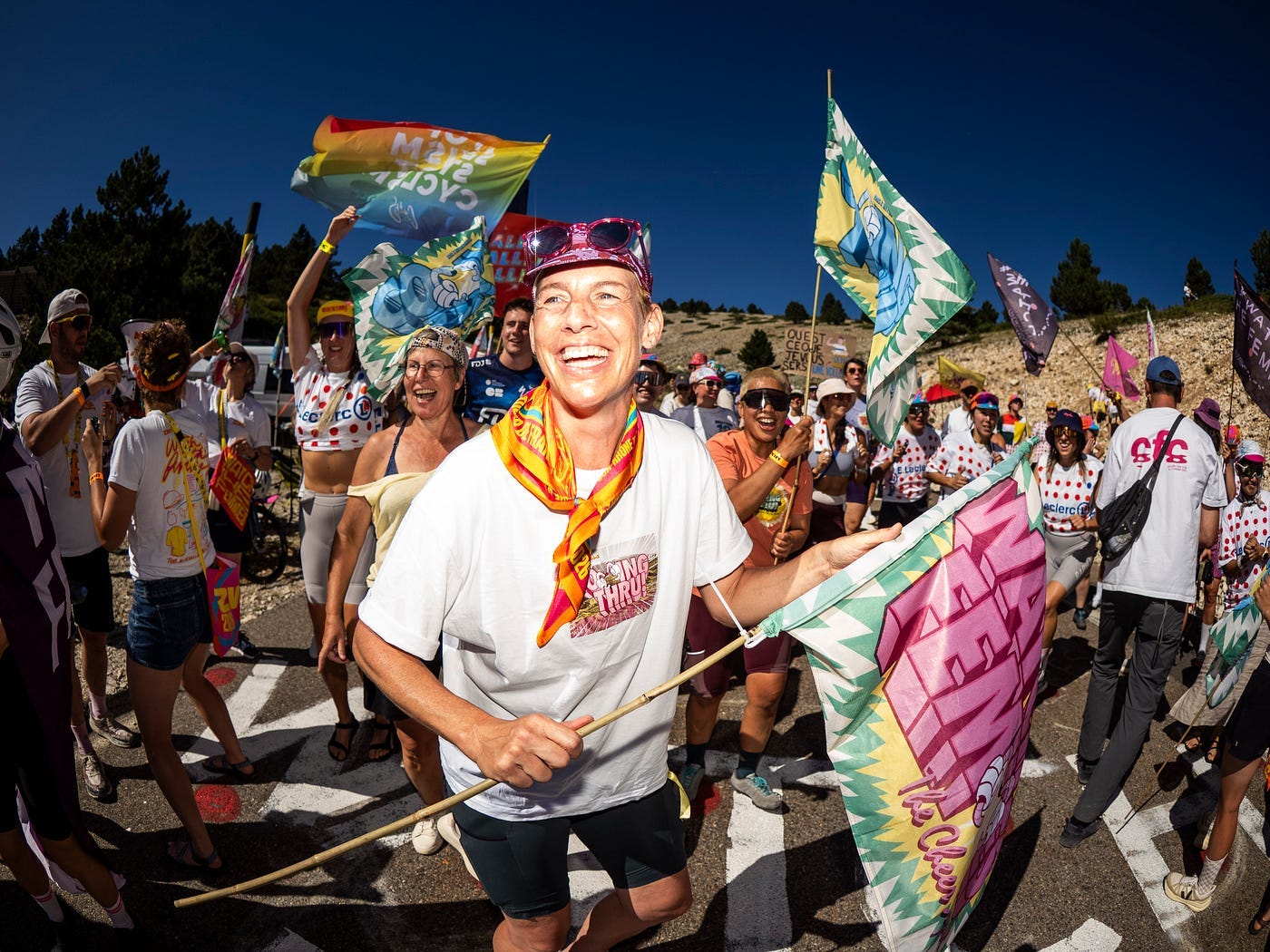
These were unique and special experiences in a country where World Tour racing does not exist. Separately, the Cheer Squad that Iris Slappendel organizes at TdFFaZ is electric and unlike any other activation in bike racing. Hundreds of women dancing to a DJ on the route before the race comes by. There’s an opportunity to do much more of this.
6. Win
Every sports team has to win. There is legitimacy that comes with winning that is irreplaceable, and we are not making the argument that performance does not matter.
Winning and having something worth following are not in competition with each other; they benefit each other. Winning gives the media operation a story to tell, and inspires fans.
Why does this matter for women’s racing?
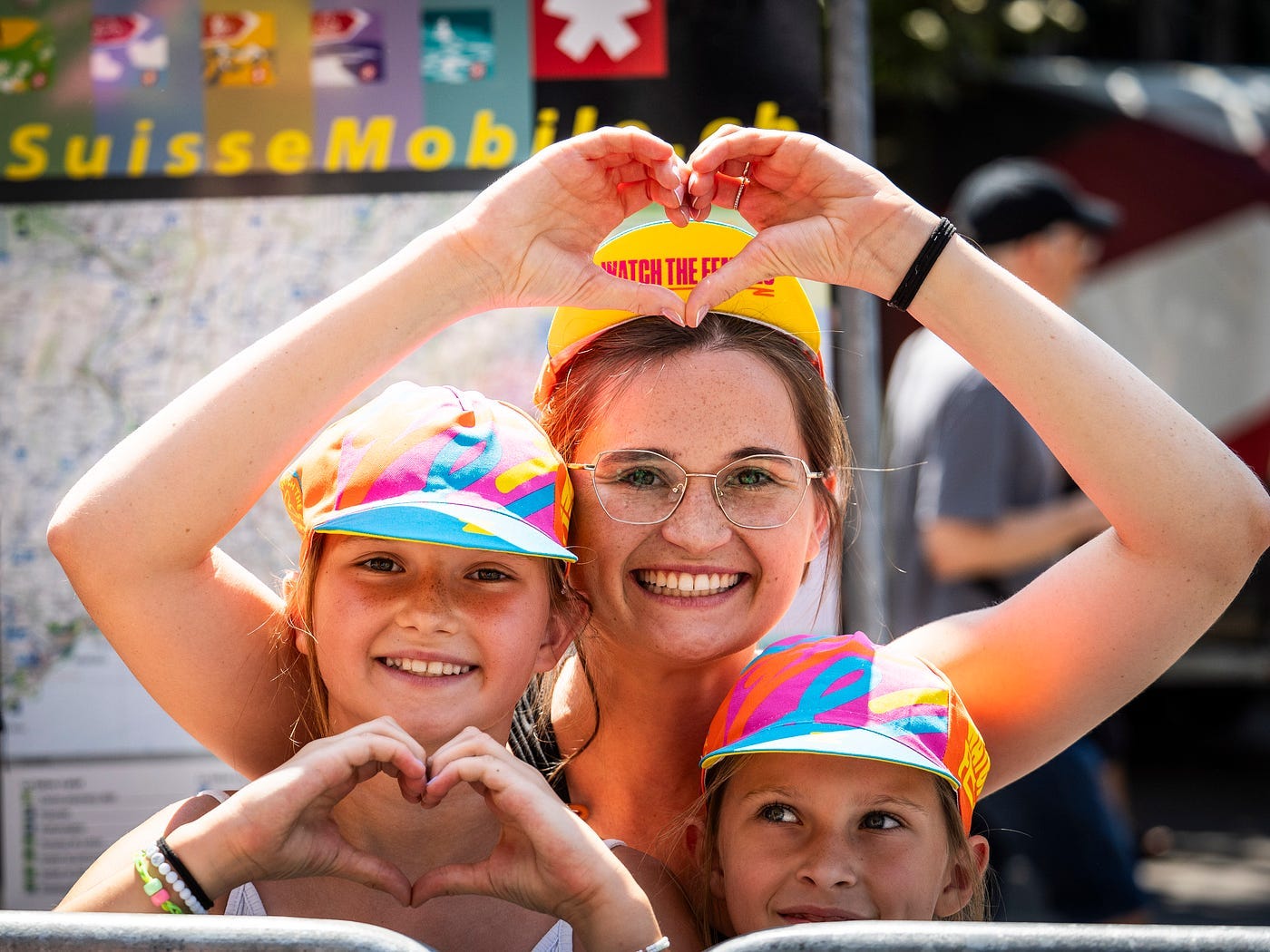
The TDFFaZ has done its job and is pulling in a new audience to the sport. With their ‘Watch the Femmes’ campaign, Zwift have converted a new generation of cycling fans, and are directly responsible for increasing female fandom within the sport. They have done the hardest, and most expensive part of the whole equation: they have made people care for the first time.
But how much of this attention belongs to the teams? It belongs to the race, the title sponsor and the individual athletes. When the nine days of the race end, how does a new fan stay engaged?
Cycling has long been a sport where fans follow riders more than teams. That has upsides, since strong riders gain profile and leverage. But riders also need strong teams to sign them, pay them and put them on the start line. Each depends on the other.
That raises a question: do fans attach to riders mainly because teams give them nothing else to attach to? Names, colours and sponsors change every year. A team with a consistent identity can keep the audience when a star rider moves on.
This is where women’s cycling has an advantage the men’s sport doesn’t. The audience is new, the teams are young, and the budgets are yet to be measured in the tens of millions. The sport is in a position to flex to the best version of itself. To do this successfully takes financial investment and time. These are two things teams are rarely keen on, and it means running performance and commercial as equals.
Teams that embrace this approach will see positive impacts on sponsor appeal, fan engagement, revenue and long-term relevance. Fans attract sponsors. Sponsors bring stability. Stability attracts riders. Riders win races, and winning brings more fans. It’s the same cycle every team is chasing. It just doesn’t start with the podium.
The Tour de France Femmes avec Zwift has created the opportunity. The teams that take it will own the next decade of women’s cycling.
For further reading, we strongly advise reading the article below by Elena Wu-Yan, and any of Natascha Knaven den Ouden’s writings for Domestique.
